Products Software supply chain security

Every third-party component verified, scanned and approved before your builds can use it.

Cold Harbour is a self-hosted software supply chain gateway. It fetches containers, packages, ML models and files from the internet on your behalf, verifies where they came from, scans every file inside them, and holds each one in quarantine until a named reviewer approves it. Only then is it published to your trusted repository, so your build network never needs to reach the internet.

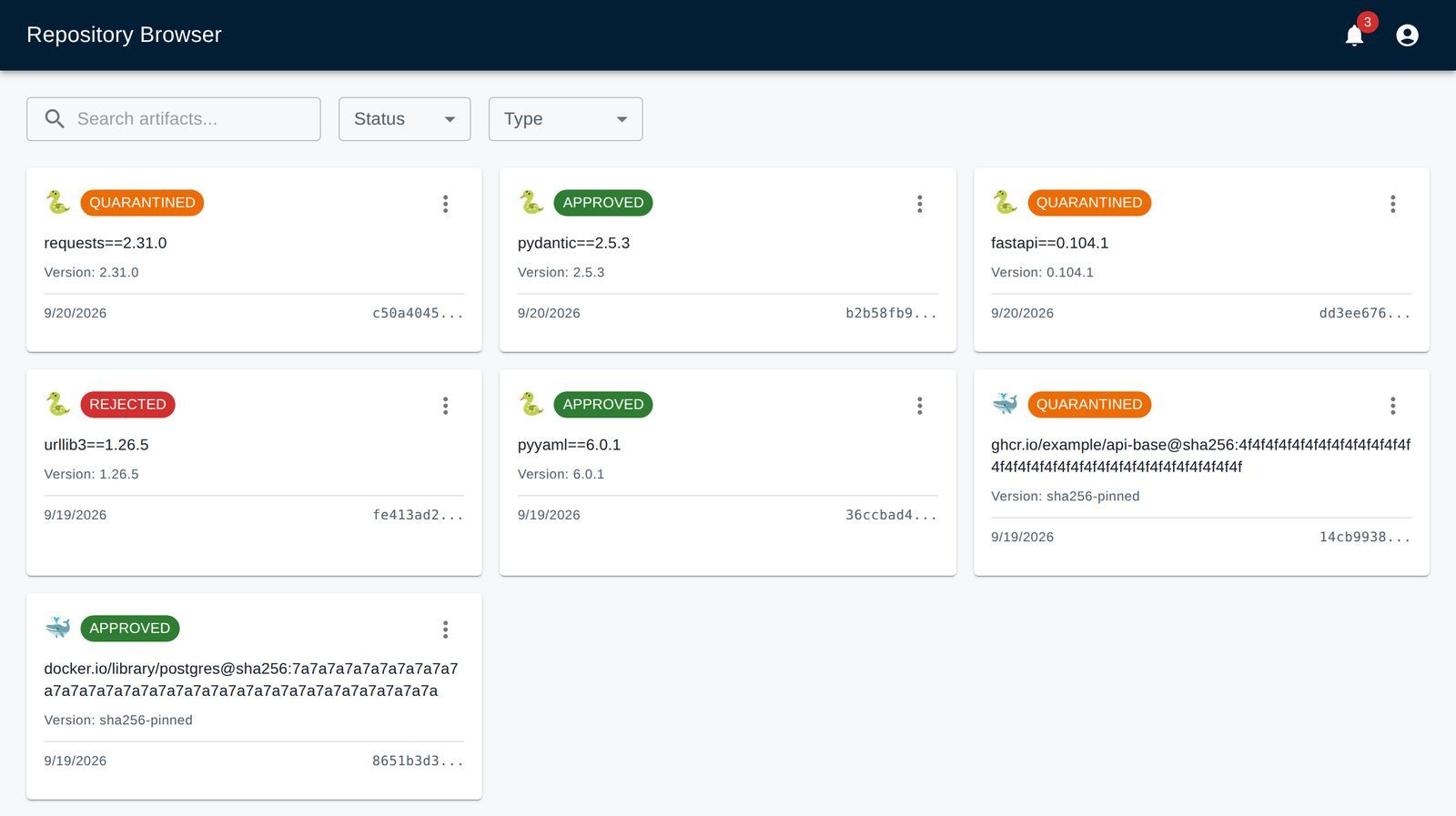
The Cold Harbour repository browser, showing Python packages and container images as quarantined, approved or rejected, each with its version and digest
Sources, from containers to removable media, through one pipeline
10
Gates, none of them optional in production
7
Direct internet pulls from your build network
0
Of decisions recorded as evidence
100%

Every gate fails closed. A scanner that is missing or fails records the scan as not performed, never as clean, and the component cannot be promoted.

Control without slowing your teams down

One controlled door for every component

Developers and build pipelines request what they need through the console, the command line or the API, with a pinned version and a business reason. The gateway fetches it, not your build network, and the reason is kept with the component in the audit trail.

  • Containers, Python, npm, Maven, Go and Cargo packages, and Ubuntu packages
  • Hugging Face models, GitHub releases, and files by URL, upload or removable media
  • Exact versions and digests only, with mutable tags such as latest refused
  • Package managers and registries then pull only from your trusted repository
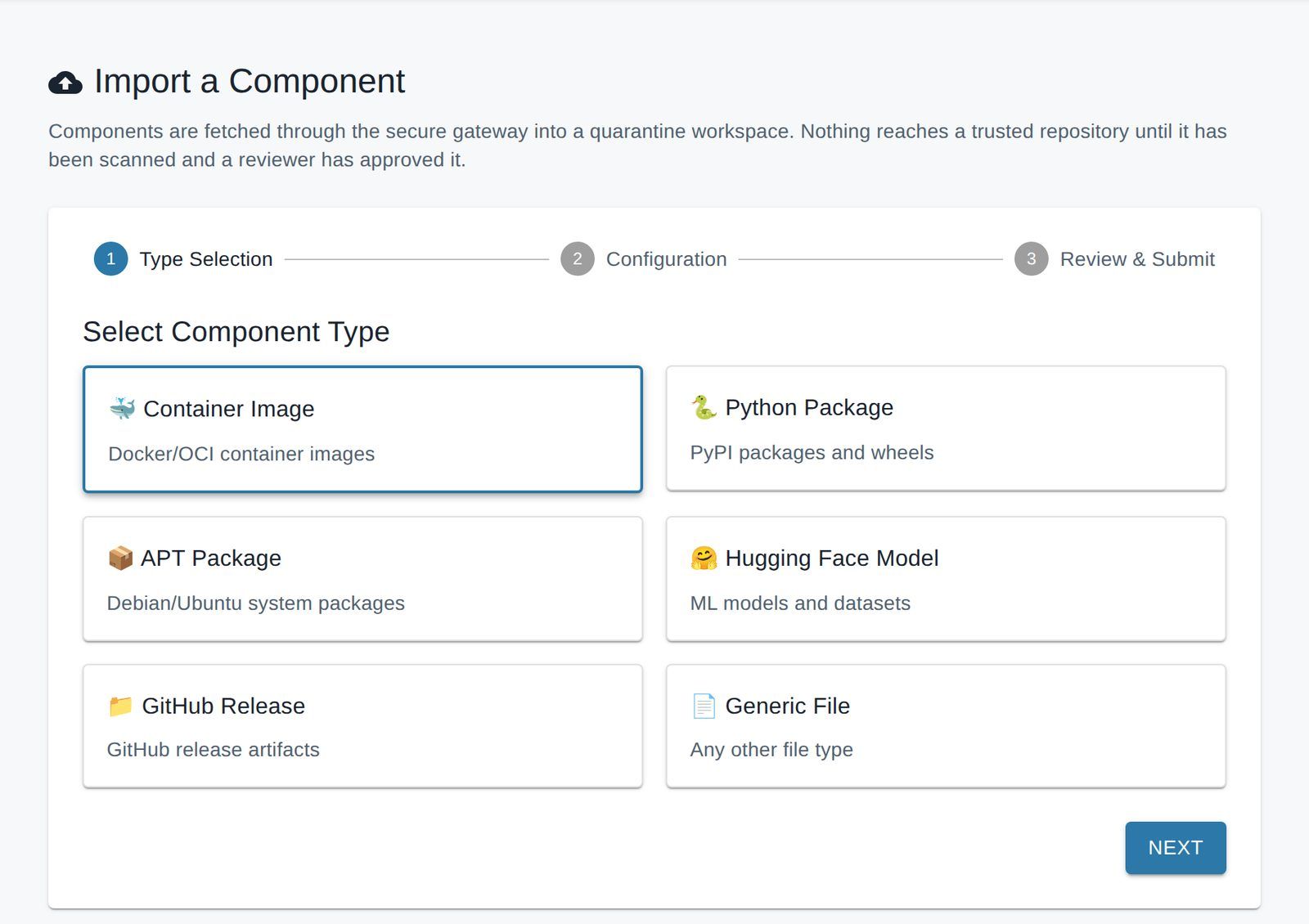
The Cold Harbour import wizard, offering container images, Python and APT packages, Hugging Face models, GitHub releases and generic files

Your rules, the same for every source

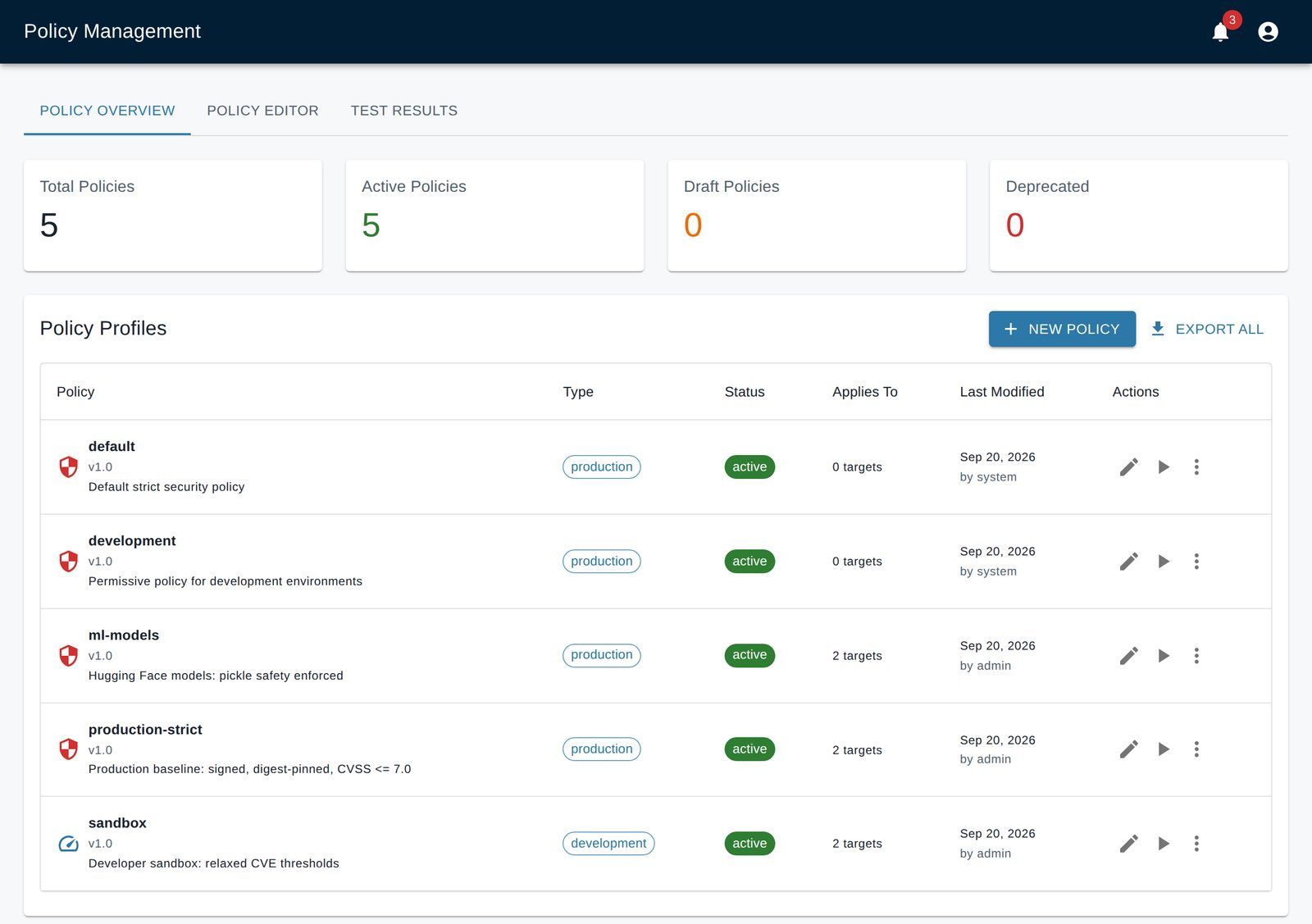
Policy profiles set what your organisation will accept: allowed sources and publishers, version pinning, vulnerability thresholds, licences, file types and sizes, and a cooling-off period for new releases. Profiles are YAML, so they live under change control, and a change to an enforced profile waits for a second administrator.

  • Separate profiles for production, development and ML models
  • Optional checks against CISA's Known Exploited Vulnerabilities catalogue
  • Documents and images rebuilt without active content where policy asks
  • Uploads and removable media stay off until a profile allows them
Cold Harbour policy management, listing default, development, ml-models, production-strict and sandbox policy profiles

Evidence an assessor can audit

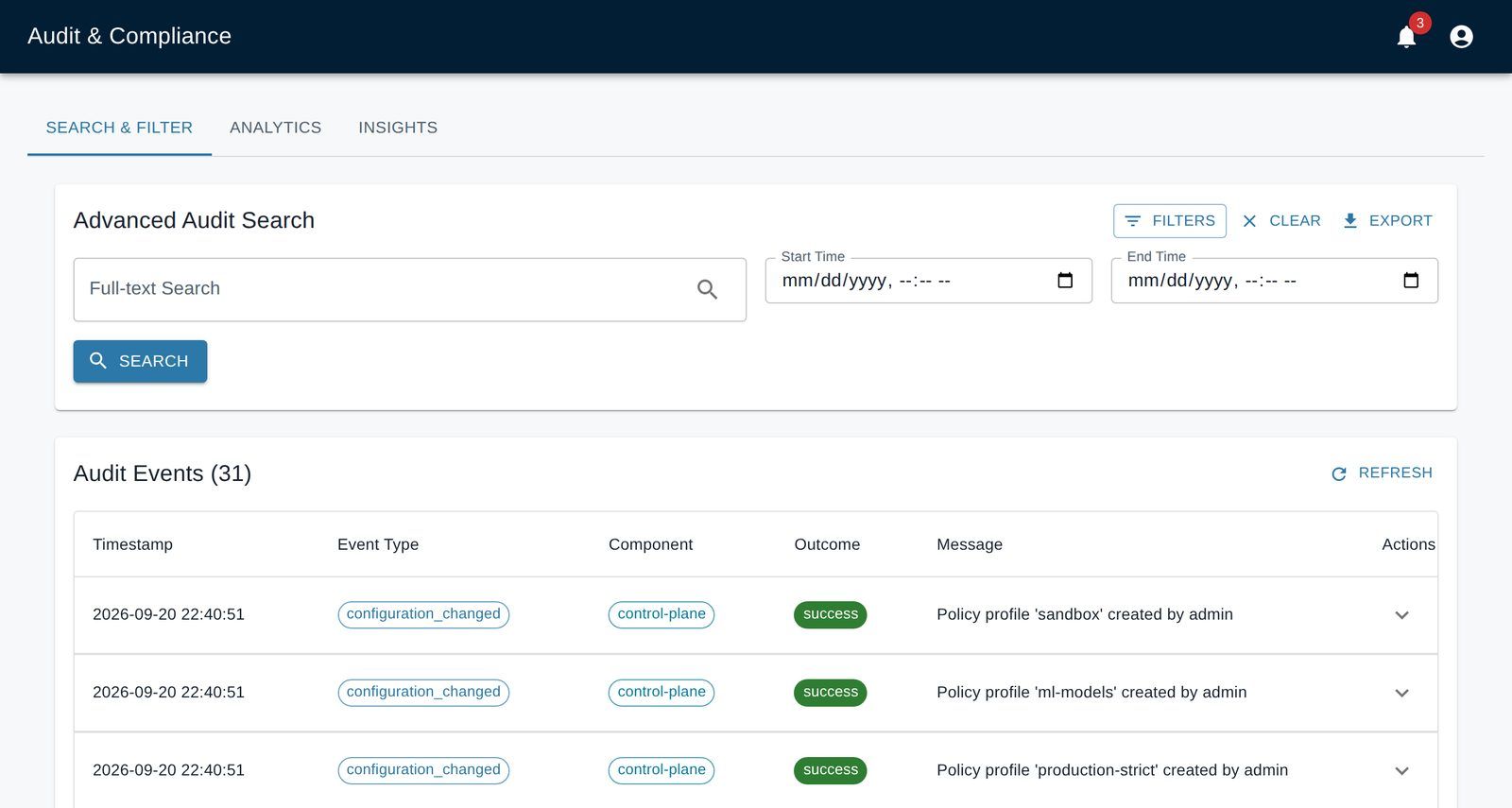
Every fetch, verification, scan verdict, policy decision, approval and promotion is written to a tamper-evident audit trail with the identity that caused it. Search it, export a date range for an evidence pack, and see that the export was itself recorded.

  • SBOMs in SPDX or CycloneDX for every artifact
  • Provenance from an artifact in your registry back to its source and its review
  • Signed daily or weekly summary reports
  • Forwarding to Splunk, Elastic or any SIEM
The Cold Harbour audit trail, with full-text and date search, export, and audit events listed by type, component and outcome

The path every component takes

Every component takes the same path, whichever ecosystem it comes from. One that cannot clear a gate goes no further.

Allowlisted

Fetched in isolation

An isolated fetcher retrieves each component over HTTPS from sources you allowlist, checking every redirect again. Your build network never makes the request.

Signed + pinned

Provenance verified

Signatures, checksums and digest pins are checked with each ecosystem's own evidence, and Windows software against signing roots you pin. A check that cannot be performed fails.

Layered

Every file scanned

Archives are unpacked and every file scanned: your own antivirus engines alongside ClamAV, YARA, threat feeds, secrets and personal data checks, known vulnerabilities, licences and unsafe ML model files.

Quarantine

Held until a person approves

Components wait in quarantine, out of reach of every build, until reviewers approve them with a written justification. Whoever requested an import can never approve it.

Signed approval

Promoted with proof

Approved artifacts are published to Harbor, Artifactory, Nexus or the built-in repository under an immutable reference, with a signed approval that CI and Kubernetes can check.

Re-scanned daily

Kept under watch

Promoted components are scanned again every day against fresh databases. New malware opens a revocation request for a person to approve.

Built for networks that must not reach the internet

Cold Harbour is built for government, defence and regulated teams whose build networks are closed. It is designed around NCSC Safely Importing Data guidance, and its controls are mapped to the NCSC Cyber Assessment Framework, the Software Security Code of Practice and the NCSC supply chain principles.

  • Sign-in with MFA for every person, through your identity provider or directory
  • Five roles, and approvals only from signed-in people, never API keys
  • Approvals from distinct reviewers, bound to the exact content
  • A production deployment refuses to start with any gate switched off
  • Scanning and parsing in isolated services with no credentials and no route out
  • A hash-chained, tamper-evident audit trail
  • Changes to an enforced policy need a second administrator
  • No telemetry: nothing is ever reported back to us

Typical uses

  • Closed and high-assurance development networks
  • Open-source packages and containers for regulated estates
  • Bringing AI models in safely
  • Files and media crossing into a closed network

Runs inside your network

  1. One stack on one host

    A single Docker Compose stack behind a TLS proxy brings up the control plane, an isolated parser service, PostgreSQL, the trusted repository, antivirus and monitoring. A modest server is enough to start.

  2. Kubernetes when you need it

    A Helm chart ships with the product, validated on RKE2 and K3s. We can scope supported deployment onto your own cluster.

  3. Air-gapped when you need it

    The gateway can be the only machine with internet access, or files can arrive from a removable-media import station. The console, documentation and scanner databases all work offline.

Questions buyers ask

Does Cold Harbour need an internet connection?

Only the gateway does, and only to the sources you allowlist, over HTTPS. Your build and developer networks need none, because they pull from the trusted repository. Fully air-gapped operation is supported too, and Cold Harbour never reports anything back to us.

What can it import?

Container images from Docker Hub and GHCR; Python, npm, Maven, Go and Cargo packages; Ubuntu packages; Hugging Face models; GitHub releases; and files by URL from hosts you allowlist, by upload, or from a removable-media import station.

What happens if a scanner is missing or fails?

The scan is recorded as not performed, never as clean, and the component cannot be promoted. The same goes for a signature check with no trust anchor configured. A production deployment will not start with a gate switched off.

Does it replace our artifact repository?

No. It promotes approved components into Harbor, JFrog Artifactory or Sonatype Nexus Repository 3, or into its own built-in repository. Artifactory and Nexus support is tested against their documented APIs, not yet against live servers.

Can it use our existing antivirus and sign-in?

Yes. Any antivirus engine with an ICAP service can scan alongside the bundled ones. People sign in through your identity provider over OpenID Connect, with SCIM provisioning, or through LDAP or Active Directory, with a second factor on top.

Is Cold Harbour accredited?

No. It is designed around NCSC guidance and its controls are mapped to the relevant frameworks, but it holds no NCSC assurance or accreditation and it is not an assured cross-domain solution, so your own assurance process applies. Control mappings, evidence templates and a penetration test scope come with it.

Will it stop every supply chain attack?

No tool can. Cold Harbour reduces the risk of importing malicious or vulnerable components; it does not eliminate it. What it guarantees is that every component was admitted deliberately, against a stated policy, by an identified person, and that you can prove it.

How is Cold Harbour licensed and supported?

It is licensed per deployment, not per component or per scan, so the price does not rise as your estate gets busier. Support is tailored to each deployment. Talk to us about your requirements.

Can we try it before committing?

Yes. We can arrange a technical walkthrough against your architecture, or a pilot in one of your non-production environments.